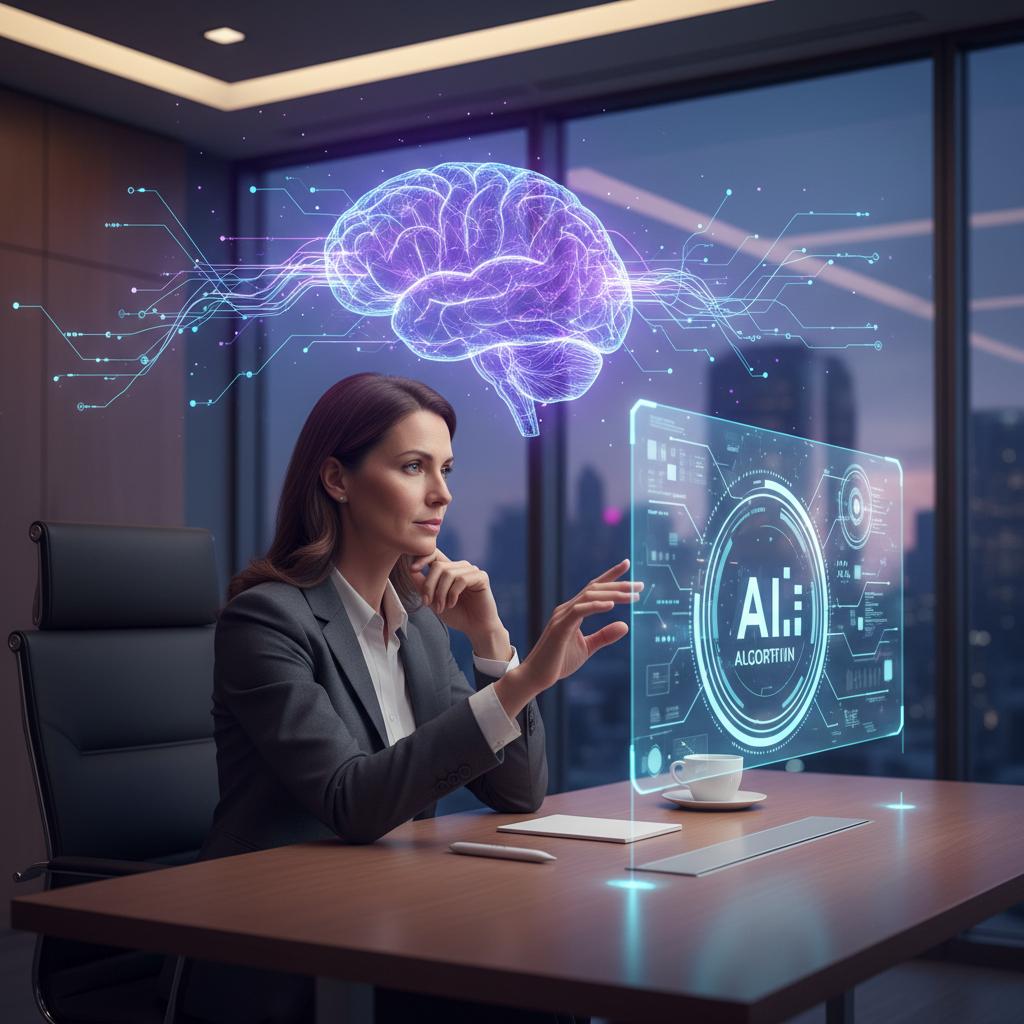

- The Cognitive Imperative: Why Psychology-Led AI Leadership is Crucial
- Beyond Algorithms: Understanding Human-AI Interplay
- Neuroplasticity in Leadership: Adapting to AI-Driven Change
- Crafting a Resilient AI Leadership Strategy: A Pinnacle Future Framework
- Strategic Foresight: Anticipating AI’s Organizational Impact
- Cultivating an AI-Ready Mindset: Overcoming Cognitive Biases
- Ethical AI Governance: A Foundation of Trust and Performance
- Optimizing Human Potential: The Neuroscience of AI-Enhanced Performance
- Cognitive Load Management: Streamlining Decision-Making with AI
- Emotional Intelligence Amplified: Leading Teams in an AI Era
- Fostering Innovation: AI as a Catalyst for Creative Problem-Solving
- Implementing a Psychology-Led AI Strategy: Practical Steps for Leaders
- Assessing Organizational Readiness: A Human-Centric Approach
- Developing Adaptive Leadership Models for AI Integration
- Measuring Impact: Quantifying Human-AI Performance Gains
- Pinnacle Future’s Vision: Shaping the Next Generation of AI Leaders
The Cognitive Imperative: Why Psychology-Led AI Leadership is Crucial
The prevailing narrative surrounding Artificial Intelligence frames its adoption as a technological challenge—a race for superior algorithms and computational power. This perspective is dangerously incomplete. The true bottleneck to realizing AI’s transformative potential is not in the silicon, but in the human mind. At Pinnacle Future, we contend that the most significant barrier to effective AI integration is the failure to upgrade the “human operating system” in parallel with the technology. A successful AI Leadership Strategy is, therefore, fundamentally a psychological one. It requires a deep, neuroscience-informed understanding of how human cognition, emotion, and behaviour interact with intelligent systems. Leaders who neglect this cognitive imperative risk not only failed implementations but also organizational friction, eroded trust, and a catastrophic loss of competitive advantage.
Beyond Algorithms: Understanding Human-AI Interplay
Viewing AI as a mere tool for automation is a profound strategic error. Intelligent systems are becoming active collaborators, creating complex human-AI dyads that reshape workflows, decision-making, and team dynamics. Effective leadership in this new paradigm requires moving beyond the technical specifications of an algorithm to master the psychology of its integration. This involves understanding how human trust is built—and broken—with non-human agents. It demands an appreciation for the psychological need for transparency and explainability in AI-driven recommendations. When a system presents a conclusion, the human cognitive response is to seek justification. Without it, trust diminishes, and adoption falters. Leaders must architect systems and processes that facilitate this psychological handshake, ensuring that AI augments, rather than alienates, human expertise.
Neuroplasticity in Leadership: Adapting to AI-Driven Change
The human brain is not a static organ; it is continuously remodelled by experience. This principle, Neuroplasticity, is the biological foundation for adaptation and learning. For leaders navigating the AI revolution, harnessing neuroplasticity is no longer a theoretical benefit but a practical necessity. An effective AI Leadership Strategy requires leaders to first rewire their own cognitive models and decision-making pathways. They must shift from being the sole source of answers to becoming the architects of systems where humans and AI solve problems together. This involves cultivating mental flexibility, embracing ambiguity, and actively challenging long-held assumptions. Crucially, these leaders must then create an environment of high psychological safety where their teams can also undergo this neuroplastic adaptation without fear of failure. At Pinnacle Future, we guide leaders in fostering this organizational neuroplasticity, building a workforce that is not just resilient to change, but actively rewired for it.
Crafting a Resilient AI Leadership Strategy: A Pinnacle Future Framework
A reactive, technology-first approach to AI is destined for mediocrity. True market leadership requires a proactive, human-centric strategy that anticipates challenges and cultivates a resilient organizational mindset. The Pinnacle Future framework is built on three pillars: strategic foresight to understand AI’s systemic impact, cognitive cultivation to prepare the minds of your people, and ethical governance to build a foundation of enduring trust. This integrated approach ensures that AI adoption is not a disruptive force but a catalyst for sustainable, high-stakes performance.
Strategic Foresight: Anticipating AI’s Organizational Impact
Strategic foresight in the age of AI extends beyond forecasting market trends. It is the C-suite capacity to model the second and third-order consequences of AI integration on the organizational psyche. How will AI-driven insights alter power dynamics and reporting structures? What new forms of collaboration will emerge, and which existing roles will become cognitively obsolete? What psychological stressors will arise from algorithmic performance management? Answering these questions requires a deep understanding of organizational psychology. Leaders must move from a project-based view of AI to a systemic one, architecting the cultural and structural evolution of their organization with the same rigour they apply to their technology stack. This is the essence of building a Scalable Human Advantage.
Cultivating an AI-Ready Mindset: Overcoming Cognitive Biases
The human brain relies on cognitive shortcuts, or biases, to navigate complexity. While efficient, these biases become significant vulnerabilities in a human-AI context. A robust AI Leadership Strategy must actively identify and mitigate these cognitive traps. Key biases include:
- Automation Bias: The tendency to over-trust and accept output from automated systems, even when it contradicts our own expertise.
- Confirmation Bias: The inclination to use AI to find data that supports pre-existing beliefs, ignoring contradictory evidence.
- Verification Neglect: The failure to apply critical scrutiny to AI-generated outputs, treating them as infallible truths rather than probabilistic suggestions.
Pinnacle Future works with leadership teams to instill a culture of what we call Decision Hygiene—a disciplined practice of critical thinking, intellectual humility, and structured verification. This cognitive inoculation is essential for transforming AI from a potential source of error into a reliable amplifier of human judgment.
Ethical AI Governance: A Foundation of Trust and Performance
Ethical AI governance is not a matter of compliance or public relations; it is a strategic imperative for high performance. Trust is the lubricant of any high-functioning organization, and in an AI-integrated environment, that trust must extend to the algorithms themselves. When employees perceive AI systems as opaque, biased, or unfair, the results are psychological resistance, disengagement, and a collapse in collaboration. A psychology-led approach to governance, as outlined by institutions like the British Psychological Society, focuses on establishing principles of fairness, accountability, and transparency. By embedding these ethical principles into the design and deployment of AI, leaders build the psychological safety required for their teams to embrace these new tools, experiment without fear, and ultimately unlock superior performance.
Optimizing Human Potential: The Neuroscience of AI-Enhanced Performance
The ultimate goal of any AI strategy should be to make its human users more capable, creative, and effective. This requires a granular understanding of the cognitive and neural mechanisms that underpin peak performance. A Neuroscience-informed approach allows leaders to design human-AI workflows that respect the brain’s limitations while amplifying its unique strengths, creating a true symbiosis that drives unprecedented results.
Cognitive Load Management: Streamlining Decision-Making with AI
The human brain has a finite capacity for processing information at any given moment, a concept known as Cognitive Load. In today’s data-saturated environments, many leaders and their teams are in a state of chronic cognitive overload, leading to decision fatigue, increased errors, and burnout. A strategic application of AI can serve as a powerful cognitive offloading tool. By automating routine data analysis, pattern recognition, and information synthesis, AI can reduce extraneous cognitive load. This frees up precious mental bandwidth, allowing humans to focus on higher-order tasks: complex problem-solving, strategic thinking, and nuanced judgment. The leader’s role is to be the architect of this cognitive partnership, ensuring AI filters the noise so their people can focus on the signal.
Emotional Intelligence Amplified: Leading Teams in an AI Era
A common misconception is that the rise of analytical AI diminishes the value of “soft skills.” The opposite is true. As AI handles more routine analytical tasks, uniquely human capabilities like empathy, persuasion, and complex social navigation become the primary drivers of value. Emotional intelligence (EQ) becomes paramount. Leaders with high EQ are better equipped to manage the anxieties and uncertainties that accompany technological change. They can articulate a compelling vision for human-AI collaboration, foster psychological safety, and coach their teams to leverage AI as a tool for deeper connection—for instance, by using AI-driven insights to better understand customer or employee sentiment. In the AI era, leadership is less about having all the answers and more about asking the right questions and managing the emotional energy of the team.
Fostering Innovation: AI as a Catalyst for Creative Problem-Solving
Innovation is not a mystical act but a cognitive process of connecting disparate ideas in novel ways. AI can be a powerful catalyst for this process. By analysing vast datasets and identifying non-obvious correlations, AI can present human teams with unexpected starting points for creative exploration. This can break down cognitive fixation and functional fixedness, allowing teams to explore solutions they would never have considered otherwise. A forward-thinking AI Leadership Strategy creates a framework for this collaborative ideation. It encourages experimentation, provides the psychological safety to test unconventional AI-generated hypotheses, and reframes the human role from being the sole engine of creativity to being the expert curator and refiner of human-AI innovation.
Implementing a Psychology-Led AI Strategy: Practical Steps for Leaders
Vision without execution is hallucination. Translating a neuroscience-informed AI strategy from the boardroom to the front line requires a deliberate, human-centric implementation plan. This involves diagnosing your organization’s cognitive readiness, evolving leadership models for a new reality, and establishing metrics that capture the true value of human-AI synergy.
Assessing Organizational Readiness: A Human-Centric Approach
Before any significant AI investment, a thorough readiness assessment is critical. However, traditional assessments focus almost exclusively on technical infrastructure and data maturity. The Pinnacle Future approach begins with the human element. We assess the organization’s cognitive and psychological readiness through diagnostic tools that measure:
- Psychological Safety: Is there a culture where employees feel safe enough to experiment with new AI tools and report failures or algorithmic anomalies without fear of blame?
- Cognitive Agility: How capable is the workforce of unlearning old processes and adapting to new, AI-driven workflows?
- Trust Baselines: What is the current level of trust in leadership and existing systems? This baseline is a critical predictor of AI adoption success.
This human-centric audit provides a clear roadmap for the cultural and leadership development needed to ensure technology is adopted effectively.
Developing Adaptive Leadership Models for AI Integration
The hierarchical, command-and-control leadership model is fundamentally incompatible with the fluid, networked nature of human-AI teams. Leaders must evolve from directors to coaches and from gatekeepers of information to facilitators of insight. This adaptive model emphasizes:
- Humility and Curiosity: Leaders must be comfortable admitting they don’t have all the answers and model a curious, experimental mindset.
- Empowerment with Guardrails: Providing teams the autonomy to leverage AI tools while establishing clear ethical and strategic boundaries.
- Systems Thinking: Focusing on designing and optimizing the overall human-AI system rather than micromanaging individual tasks.
At Pinnacle Future, we specialize in coaching executives to embody this new model, ensuring their leadership style accelerates, rather than inhibits, AI-driven performance.
Measuring Impact: Quantifying Human-AI Performance Gains
The ROI of AI cannot be measured solely by traditional metrics like cost reduction or processing speed. These fail to capture the profound impact on human cognitive performance and organizational capability. A sophisticated measurement framework must include new, human-centric KPIs.
| Traditional AI Metrics | Psychology-Led Performance Metrics |
|---|---|
| Tasks Automated / Hour | Decision Quality & Velocity Index |
| Cost Savings | Innovation Rate (e.g., new hypotheses tested) |
| System Uptime | Employee Cognitive Load Reduction |
| Data Processing Speed | Psychological Safety & Engagement Scores |
By adopting this balanced scorecard, leaders can demonstrate the true value of their AI Leadership Strategy—not just in terms of efficiency, but in the creation of a smarter, faster, and more adaptive organization. This is the Scalable Human Advantage that defines market leaders.
Pinnacle Future’s Vision: Shaping the Next Generation of AI Leaders
The integration of artificial intelligence is the defining leadership challenge of our generation. Organizations that treat it as a mere technological upgrade will be outmanoeuvred by those who recognize it as a fundamental shift in the human-machine paradigm. The future does not belong to the companies with the best algorithms alone; it belongs to the organizations that can seamlessly fuse computational power with optimized human cognition. This requires a new calibre of leader—one who is fluent in both technology and psychology, who can architect systems of trust, and who can inspire their people to achieve new levels of performance in partnership with intelligent machines. At Pinnacle Future, our singular mission is to cultivate these leaders. We provide the neuroscience-based frameworks and executive coaching necessary to upgrade the human operating system, transforming the profound challenges of AI adoption into your organization’s most significant competitive advantage. To explore how a psychology-led approach can redefine your AI strategy, we invite you to schedule a Confidential Leadership Consultation.