
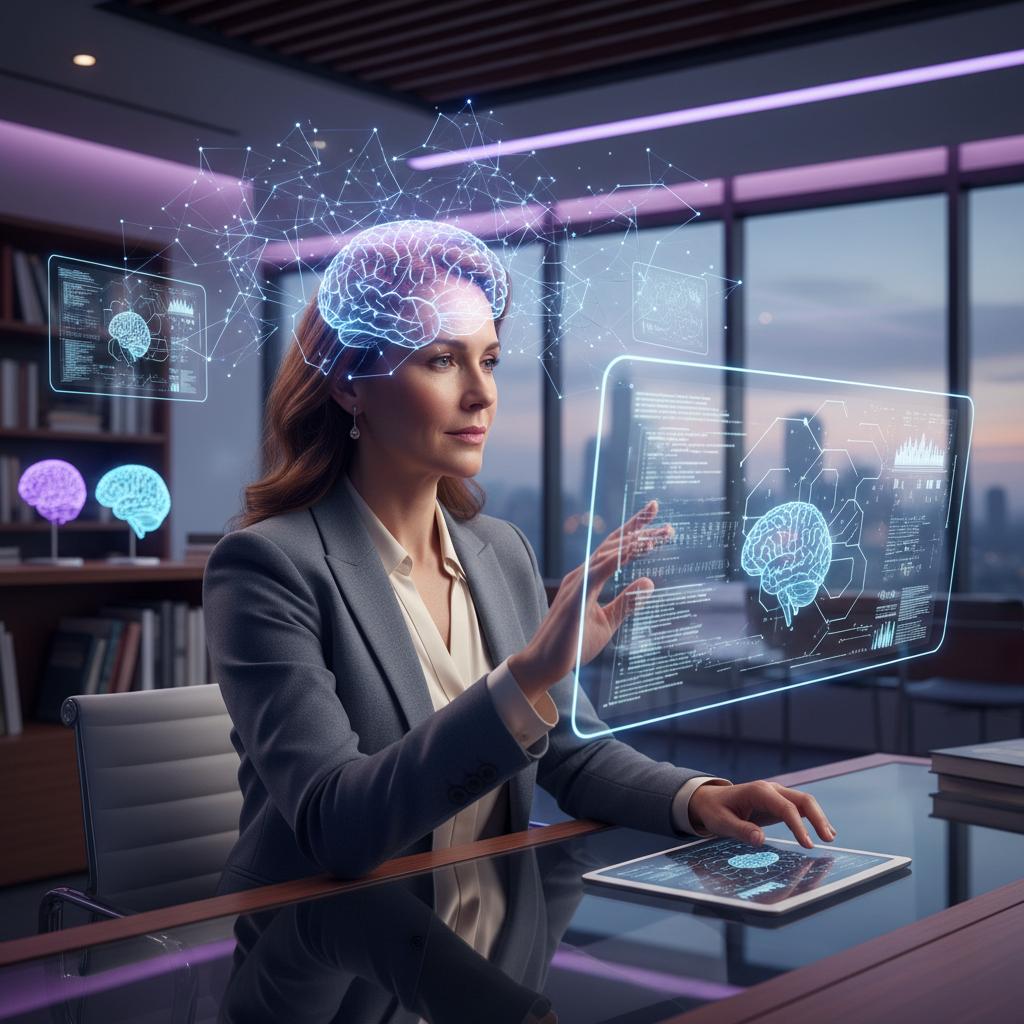
- The Cognitive Imperative: Why Psychology Drives Successful AI Adoption
- Deconstructing Resistance: Psychological Barriers to AI Integration
- Blueprint for Acceptance: Neuroscience-Informed Strategies for AI Rollout
- Measuring Mindset Shifts: Quantifying Psychological Readiness for AI Integration
- Pinnacle Future’s Approach: Integrating Human Cognition with AI Strategy for Sustainable Growth
- Conclusion: The Future of Work is Human-Centric AI Adoption
The Cognitive Imperative: Why Psychology Drives Successful AI Adoption
The prevailing narrative surrounding Artificial Intelligence adoption is dangerously incomplete. It is a dialogue dominated by algorithms, data infrastructure, and computational power. While these technological pillars are essential, they represent only half of the equation. The most significant, and frequently ignored, variable in the success of any AI initiative is the intricate, powerful, and often unpredictable architecture of the human brain. At Pinnacle Future, we contend that the primary bottleneck to realizing AI’s transformative potential is not technological; it is psychological. Failing to address the human operating system—its cognitive biases, emotional triggers, and neurological responses to change—renders even the most sophisticated AI strategy inert. True competitive advantage in this new era will not belong to the organization with the best technology, but to the one that masters the psychology of its integration.
Beyond Algorithms: Understanding Human-AI Symbiosis
The objective of AI adoption must transcend the limited concept of a ‘tool’. The ultimate goal is to foster a state of human-AI symbiosis: a fluid cognitive partnership where the strengths of both machine and human intelligence are amplified. This requires a profound understanding of human cognitive architecture. When an individual interacts with a new AI system, their brain must process novel information, adapt existing workflows, and manage uncertainty. This creates Cognitive Load, a tax on our finite mental resources. A poorly designed AI integration overwhelms this capacity, leading to frustration, errors, and eventual abandonment. A Psychology-led AI Adoption strategy, by contrast, designs the entire human-AI interface to minimize friction and optimize this cognitive partnership. It calibrates the system to augment human intuition, creativity, and strategic thought, while offloading the repetitive, data-intensive tasks that lead to cognitive fatigue and burnout. This is not about human-computer interaction; it is about creating a unified, high-performance cognitive unit.
Deconstructing Resistance: Psychological Barriers to AI Integration
Organizational resistance to AI is not a character flaw or a simple aversion to progress. It is a predictable, deeply ingrained neurobiological and psychological response to a perceived threat. To dismiss this resistance is to ignore the fundamental workings of the human mind. A strategy that fails to account for these psychological undercurrents is destined for failure. Effective leadership requires deconstructing these barriers at their source, moving beyond superficial change management tactics to address the core cognitive and emotional drivers of human behaviour.
The Amygdala Response: Addressing Fear and Uncertainty in AI Rollout
Deep within the brain’s temporal lobe lies the amygdala, our primal threat detection centre. When faced with significant uncertainty—such as the introduction of AI and its implications for job security, status, and autonomy—the amygdala triggers a powerful ‘fight-or-flight’ response. This neurological alarm floods the system with stress hormones, inhibiting activity in the prefrontal cortex, the seat of rational thought and executive function. In this state, an employee cannot logically assess the benefits of an AI tool. Instead, they perceive it as a predator. This manifests as active pushback, subtle sabotage, or passive non-compliance. A standard IT rollout plan, with its focus on features and timelines, completely fails to soothe this amygdala hijack. A Neuroscience-informed approach, however, prioritizes communication strategies that build Psychological Safety, reduce ambiguity, and give individuals a sense of agency, thereby calming the brain’s threat response and creating a state of receptivity to change.
Cognitive Biases: Navigating Perceptual Challenges in AI Acceptance
The human brain relies on mental shortcuts, or heuristics, to navigate a complex world. During times of change, these cognitive biases can become significant obstacles to rational decision-making and AI acceptance.
- Automation Bias: This is the tendency to over-rely on automated systems and trust their outputs implicitly, even when evidence suggests an error. It can lead to a dangerous abdication of critical thinking and human oversight.
- Algorithm Aversion: The converse of automation bias, this occurs when individuals reject a superior algorithm’s advice after witnessing it make even a minor error, while simultaneously forgiving similar or greater errors made by a human peer.
- Confirmation Bias: A powerful driver of resistance, this is the tendency to seek out and interpret information that confirms pre-existing beliefs. If an employee believes AI will make their role obsolete, they will selectively focus on news and anecdotes that support this fear, while ignoring evidence of AI as an augmentation tool.
- Verification Neglect: This bias describes our tendency to avoid the cognitive effort of cross-referencing or verifying AI-generated information, particularly when it appears plausible. This can lead to the rapid propagation of errors and a decline in overall Decision Hygiene.
A psychology-led strategy actively identifies and designs interventions to mitigate these biases, fostering a culture of mindful, critical engagement with AI systems.
Blueprint for Acceptance: Neuroscience-Informed Strategies for AI Rollout
Overcoming deep-seated psychological barriers requires a more sophisticated blueprint than a traditional project plan. Instead of attempting to force change against the grain of human nature, a Neuroscience-informed strategy works with the brain’s natural tendencies. It focuses on creating the optimal cognitive and emotional conditions for acceptance, transforming resistance into advocacy by systematically building trust, reinforcing positive behaviours, and leveraging leadership to shape the collective organizational mindset.
Cultivating Trust: Transparency and Explainable AI (XAI) from a Human Perspective
Trust is not a feature to be toggled on; it is a neurological state built on predictability and perceived benevolence. For the human brain, the “black box” nature of many AI systems is a significant source of uncertainty, which, as we know, activates a threat response. Explainable AI (XAI) is therefore not merely a technical or ethical requirement—it is a psychological imperative. Providing clear, intuitive explanations for how an AI reaches its conclusions satisfies the brain’s deep-seated need to understand causality. This transparency reduces ambiguity, disarms the amygdala’s fear response, and shifts the user’s perception of AI from an inscrutable oracle to a reliable, understandable collaborator. As highlighted by research from institutions like The British Psychological Society, building this trust is fundamental to the ethical and effective deployment of AI. More on this topic can be explored at authoritative sources like the BPS website.
Reinforcement Learning for Humans: Shaping Positive AI Interactions
The same principles of reinforcement that train machine learning models can be applied to encourage human adoption. Every interaction with a new AI system is an opportunity to shape future behaviour. By designing AI workflows that deliver immediate, tangible benefits and small, early wins, we can activate the brain’s dopaminergic reward pathways. This release of dopamine creates a positive feedback loop, reinforcing the new behaviour and accelerating the formation of new habits. Instead of relying on mandates, this approach fosters intrinsic motivation. It involves celebrating early adopters, clearly showcasing how the AI reduces tedious work, and ensuring the user interface is so intuitive that the path of least resistance is the path of adoption. This is behavioural science applied to digital transformation.
Leadership as a Neural Pathway: Guiding Organizational Mindsets Towards AI
In any organizational change, leaders are not just managers; they are neuro-leaders. Their attitudes, language, and behaviours are contagious, shaping the collective emotional and cognitive state of the entire organization through mechanisms like mirror neurons and emotional contagion. If leadership signals fear, skepticism, or ambiguity about AI, that uncertainty will cascade through the ranks. Conversely, leaders who model curiosity, demonstrate vulnerability by learning the new systems publicly, and consistently frame AI as a collaborative partner create the crucial foundation of Psychological Safety. They must architect a new narrative—one of augmentation, not replacement. This role goes far beyond project sponsorship; it is about actively sculpting the organization’s neural pathways towards a future of confident, empowered human-AI collaboration.
Measuring Mindset Shifts: Quantifying Psychological Readiness for AI Integration
Traditional metrics for technology adoption—such as login rates, feature usage, or tickets resolved—are woefully inadequate for measuring the success of an AI integration. They measure superficial compliance, not deep cognitive and emotional conviction. A truly AI-ready organization is defined by its mindset, not its usage statistics. At Pinnacle Future, we deploy validated psychometric instruments and qualitative frameworks to measure the variables that truly matter:
- Cognitive Trust: The degree to which employees believe an AI system is competent, reliable, and aligned with their goals.
- Psychological Safety Index: A measure of the perceived safety within a team to experiment, ask questions, and even fail with new AI tools without fear of judgment or reprisal.
- AI Efficacy Beliefs: The extent to which the workforce believes that AI will genuinely enhance their capabilities and the organization’s performance.
- Growth Mindset Orientation: An assessment of the underlying belief that abilities and intelligence can be developed, a critical prerequisite for adapting to new, AI-driven ways of working.
Tracking these deep psychological indicators provides a genuine barometer of an organization’s readiness and allows for targeted interventions to address specific cognitive and cultural barriers before they derail the entire initiative.
Pinnacle Future’s Approach: Integrating Human Cognition with AI Strategy for Sustainable Growth
Pinnacle Future operates at the critical intersection where advanced technology meets human psychology. We recognize that sustainable AI adoption is not achieved by installing software, but by upgrading the human operating system. Our proprietary methodology moves beyond the limitations of traditional, tech-led change management to address the core neurological and psychological constraints that determine success or failure. We architect strategies that build cognitive trust, mitigate innate biases, and foster true human-AI symbiosis, delivering what we call a Scalable Human Advantage. The difference in approach and outcome is stark.
| Feature | Traditional Tech-Led Adoption | Pinnacle Future’s Psychology-led AI Adoption |
|---|---|---|
| Primary Focus | System functionality, data integration, process automation. | Human cognition, emotional response, trust-building. |
| Resistance Management | Top-down mandates, remedial training, user guides. | Amygdala-aware communication, bias mitigation, psychological safety protocols. |
| Success Metrics | User logins, process efficiency, error reduction. | Cognitive trust scores, psychological safety indices, mindset shift velocity. |
| Leadership Role | Project sponsorship and resource allocation. | Active mindset modeling, emotional regulation, narrative shaping. |
| Long-Term Outcome | Incremental efficiency gains, often with persistent user friction. | Sustainable human-AI symbiosis, high-impact innovation, and competitive differentiation. |
To explore how our Neuroscience-informed frameworks can de-risk your AI initiatives and unlock your organization’s full potential, we invite you to a Confidential Leadership Consultation. Learn more about our philosophy at https://pinnacle-future.com/.
Conclusion: The Future of Work is Human-Centric AI Adoption
The global race for AI supremacy is being run on the wrong track. It will not be won by the company with the most powerful algorithms or the largest datasets, but by the one that most profoundly understands and architects for the human mind. An AI strategy that ignores psychology is an exercise in futility, destined to collide with the intractable and predictable wall of human resistance, fear, and bias. Psychology-led AI Adoption is not a “soft” competency; it is the single most critical strategic discipline for the modern enterprise. It is the science of turning technological potential into human performance. The future of work is not a choice between human and machine, but a carefully cultivated partnership between them. Building that partnership is the definitive challenge of our time, and the core mission of Pinnacle Future.