
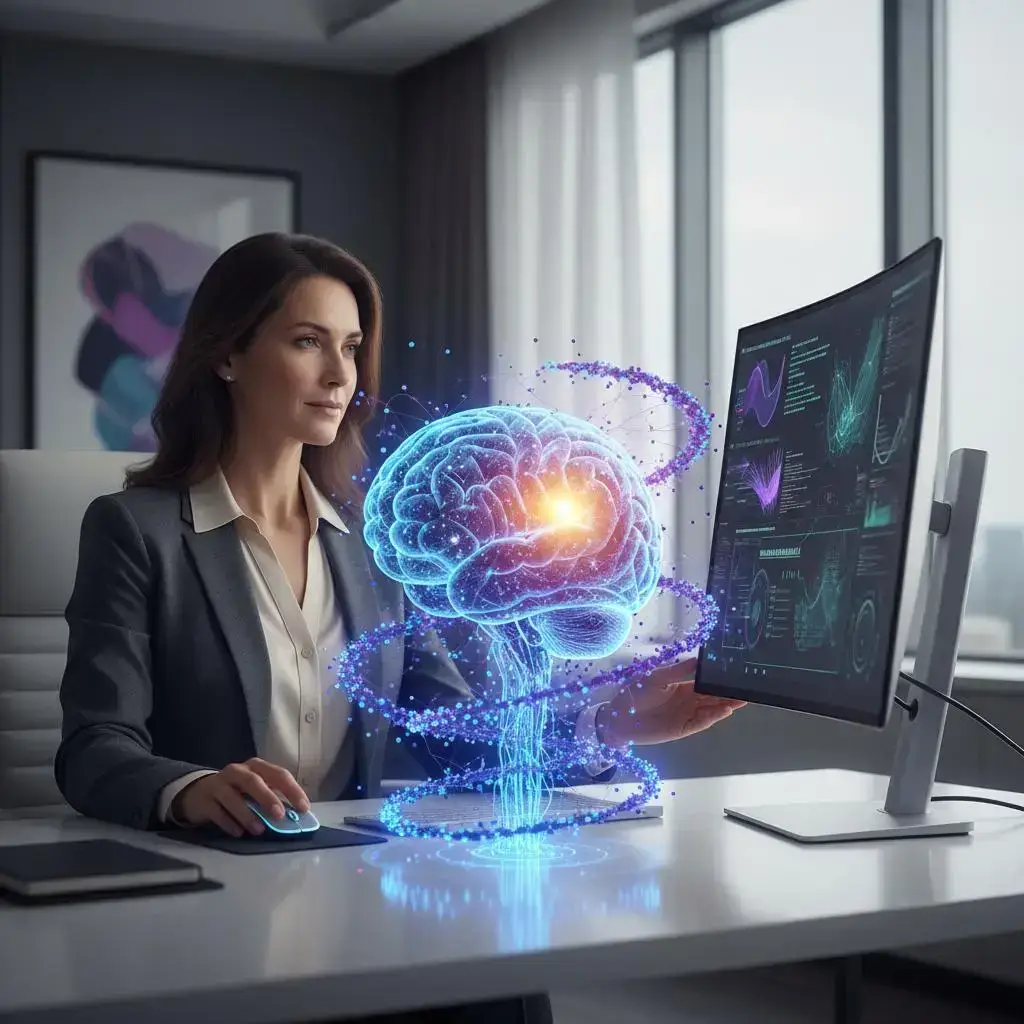
- The Cognitive Imperative: Why Psychology Drives AI Leadership Success
- Neuroleadership in Action: Cultivating an AI-Ready Organizational Mindset
- Architecting Human-Centric AI Adoption: A Neuroscience-Informed Blueprint
- Measuring Impact Beyond Metrics: Cognitive Enhancement and Organizational Resilience
- Pinnacle Future’s Distinctive Approach: Integrating Mind and Machine for Unrivaled AI Leadership
The Cognitive Imperative: Why Psychology Drives AI Leadership Success
The prevailing discourse on artificial intelligence has been disproportionately dominated by technology—algorithms, data sets, and processing power. While these elements are foundational, they represent only half of the equation. The true determinant of success in this new era is not the sophistication of the machine, but the acuity of the human mind leading it. An effective AI Leadership Strategy is, at its core, a human strategy. It is an exercise in understanding and optimizing the most complex system known: the human brain. At Pinnacle Future, we posit that the fundamental constraints of AI adoption are not technical, but psychological. Overcoming them requires a deliberate upgrade to the “human operating system” itself.
Decoding Human-AI Symbiosis for Strategic Advantage
Viewing AI as a mere tool for automation is a profound strategic error. The most forward-thinking leaders are architecting a state of Human-AI Symbiosis, where machine intelligence augments human cognition, creating a partnership that vastly outperforms either entity alone. This requires a deep, Neuroscience-informed understanding of cognitive processes. For instance, strategically offloading computationally intensive but low-intuition tasks to AI can significantly reduce executive Cognitive Load. This frees up vital neural resources in the prefrontal cortex for higher-order functions: strategic foresight, creative problem-solving, and nuanced ethical reasoning. The goal is not to replace human thought, but to elevate it. A successful symbiotic framework is one where AI handles the calculation, allowing leaders to focus on calibration, context, and consequence.
Mitigating Cognitive Biases in AI Decision-Making
AI systems, trained on historical data, can inadvertently inherit, amplify, and entrench human biases. Leaders who are unaware of their own cognitive heuristics risk creating feedback loops that validate flawed assumptions with machine-driven speed and scale. For example, Confirmation Bias—the tendency to favor information that confirms pre-existing beliefs—can lead a leader to selectively interpret AI-generated outputs. A more insidious risk is Verification Neglect, where the sheer volume and perceived authority of AI analysis leads to a dangerous abdication of critical scrutiny. An advanced AI Leadership Strategy must therefore incorporate rigorous practices of Decision Hygiene. This involves designing processes that systematically challenge assumptions, demand dissenting data points, and build in “cognitive circuit breakers” to force deliberative, conscious reflection before high-stakes decisions are finalized based on AI recommendations.
Neuroleadership in Action: Cultivating an AI-Ready Organizational Mindset
Deploying AI is not a simple software rollout; it is a profound cultural and psychological transformation. A technically perfect system will fail if the organizational mindset is not prepared for it. Neuroleadership—the application of neuroscience to leadership practices—provides the essential framework for cultivating this AI-ready culture from the top down.
Fostering Psychological Safety for AI Experimentation
Innovation with AI is inherently experimental and involves a high degree of uncertainty. From a neuroscience perspective, uncertainty and the fear of failure trigger the amygdala, the brain’s threat-detection center. This threat response shuts down the prefrontal cortex, stifling creativity, collaboration, and learning. Leaders must therefore engineer an environment of high Psychological Safety. This means explicitly framing AI-related “failures” as data-rich learning opportunities, rewarding intelligent risk-taking, and decoupling experimental outcomes from individual performance metrics. When team members feel safe to explore, question, and even challenge AI systems without fear of reprisal, the organization’s capacity for genuine, breakthrough innovation expands exponentially.
The Role of Emotional Intelligence in Guiding AI Transformation
Paradoxically, as organizations become more technologically advanced, the premium on distinctly human skills like Emotional Intelligence (EQ) skyrockets. AI transformation inevitably creates anxiety, resistance, and ambiguity. A leader with high EQ can accurately perceive and skillfully manage these emotional currents. They can articulate a compelling, human-centric vision that reduces fear, build coalitions based on trust and empathy, and navigate the complex interpersonal dynamics that arise when roles and workflows are redefined. This is not a “soft skill”; it is a critical competency for de-risking a multi-million-dollar technology investment and ensuring that the human workforce remains engaged, motivated, and aligned with the strategic vision.
Architecting Human-Centric AI Adoption: A Neuroscience-Informed Blueprint
A sustainable AI strategy is designed with the human brain as the end-user. It anticipates cognitive bottlenecks, respects psychological needs, and builds systems that are not just powerful, but also trustworthy and interpretable. This human-centric approach is the only way to ensure deep, lasting adoption.
Designing for Trust and Transparency in AI Systems
Trust is a neurobiological state, not a logical deduction. It is fragile and difficult to build, particularly with opaque “black box” AI systems. When users do not understand the reasoning behind an AI’s output, they are less likely to rely on it for critical tasks, leading to poor adoption and wasted investment. Architecting for trust involves implementing explainable AI (XAI) principles not just as a technical feature, but as a core component of the user experience. The goal is to provide a level of transparency that aligns with the user’s mental model, reducing uncertainty and enabling them to build a reliable, calibrated sense of the system’s capabilities and limitations.
Ethical AI Frameworks Through a Behavioral Science Lens
Many organizations approach AI ethics with a compliance-based, checklist mentality. This is insufficient. Pinnacle Future advocates for an approach grounded in Applied Behavioral Science. An ethical AI framework should not just define rules, but also design “choice architectures” that nudge users toward ethical behaviors. This involves understanding how factors like time pressure, cognitive load, and social proof influence decision-making in human-AI interactions. By embedding ethical considerations into the workflow and interface design, we move from a reactive, compliance-focused stance to a proactive culture of ethical responsibility. For further reading on professional ethics in technology, resources from authoritative bodies like the British Psychological Society offer crucial guidance.
Measuring Impact Beyond Metrics: Cognitive Enhancement and Organizational Resilience
The true ROI of a sophisticated AI Leadership Strategy is not fully captured by traditional productivity metrics. The most significant gains are in the enhancement of human cognitive capabilities and the cultivation of a more agile, resilient organization.
Quantifying Human-AI Performance Gains and Adaptability
To measure what truly matters, leaders must adopt a new scorecard. Instead of focusing solely on efficiency gains, we must quantify the impact on human performance and organizational capacity. This requires shifting from lagging indicators of output to leading indicators of capability. The table below illustrates the contrast between conventional and Neuroscience-informed metrics.
| Metric Focus | Traditional AI Metrics | Neuroscience-Informed Metrics |
|---|---|---|
| Performance | Task completion time, error rates | Cognitive load reduction, decision velocity & quality |
| Adoption | User logins, feature usage | Psychological safety scores, cross-functional collaboration rates |
| Innovation | Number of new AI projects | Rate of successful experimentation, creative problem-solving capacity |
| Resilience | System uptime, data accuracy | Organizational adaptability index, workforce reskilling velocity |
Sustaining AI Momentum Through Applied Behavioral Science
The initial excitement of an AI launch often fades, leading to a plateau in adoption and impact. Sustaining momentum requires the systematic application of behavioral science principles. This includes designing feedback loops that provide immediate, positive reinforcement for desired behaviors, using social proof to highlight and encourage adoption by influential teams, and breaking down the complex process of learning new AI-driven workflows into small, manageable habits. By architecting the journey for the human brain, leaders can transform a one-time project into a self-reinforcing cycle of continuous improvement and adaptation, ensuring the organization’s AI capabilities evolve and deepen over time.
Pinnacle Future’s Distinctive Approach: Integrating Mind and Machine for Unrivaled AI Leadership
The successful integration of AI is the definitive leadership challenge of our time. It is a test not of technical prowess, but of human insight. At Pinnacle Future, we operate at the intersection of neuroscience, psychology, and strategic leadership to address the fundamental human challenges that determine the success or failure of AI initiatives. Our unique methodology focuses on upgrading your organization’s most valuable asset: the collective intelligence and cognitive performance of your people. We move beyond the technology to architect a culture of trust, psychological safety, and true Human-AI Symbiosis. By focusing on the “human operating system,” we provide leaders with the framework to unlock a Scalable Human Advantage that technology alone cannot replicate. To explore how our psychology-led, neuroscience-informed approach can de-risk and accelerate your AI transformation, we invite you to arrange a Confidential Leadership Consultation.